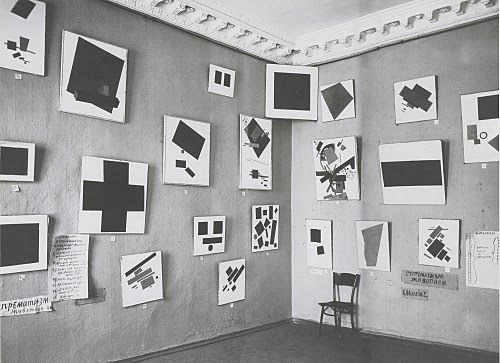
Kazimir Malevich is most often associated with the radical simplicity of Suprematism, yet his artistic vision extended far beyond the canvas. In his later explorations, Malevich became increasingly interested in how color and form could shape not only visual perception but also the psychological experience of space itself. This led him to experiment with the idea of walls—not merely as surfaces for paintings, but as active elements in creating an immersive environment.
For Malevich, color was not decorative; it was a force. He believed that pure color and geometric form could evoke direct emotional and spiritual responses, bypassing narrative and representation. When applied to walls, these principles transformed entire spaces into what could be described as psychological fields. A room was no longer neutral—it became charged with energy, mood, and rhythm through carefully considered color relationships.
These ideas aligned with early 20th-century avant-garde attempts to dissolve the boundary between art and life. Malevich imagined environments where walls, objects, and human presence interacted as a unified composition. Color could expand or compress perceived space, create tension or calm, and guide the viewer’s movement and attention. In this sense, his work anticipated later developments in installation art and environmental design.
From a psychological perspective, Malevich’s experiments suggest an intuitive understanding of how color influences human emotion. Warm tones can stimulate and activate, while cooler tones tend to calm and distance. By reducing visual language to essential elements—color, shape, and spatial arrangement—Malevich sought to access a more immediate level of perception, one that resonates with subconscious responses rather than analytical thought.
In his exploration of color’s emotional impact, Malevich emphasized the distinct psychological qualities of individual hues. Red, for example, was associated with energy, movement, and inner tension—an activating force within space. Blue, by contrast, suggested depth, calm, and a sense of infinity, often creating a meditative or distancing effect. Yellow carried a sense of light, expansion, and warmth, while black represented silence, potential, and a kind of metaphysical void. White, especially significant in his later work, symbolized pure space and freedom, offering a sense of openness and release. Through these color relationships, Malevich demonstrated how carefully structured environments could evoke specific emotional states, turning space itself into a subtle but powerful psychological experience.